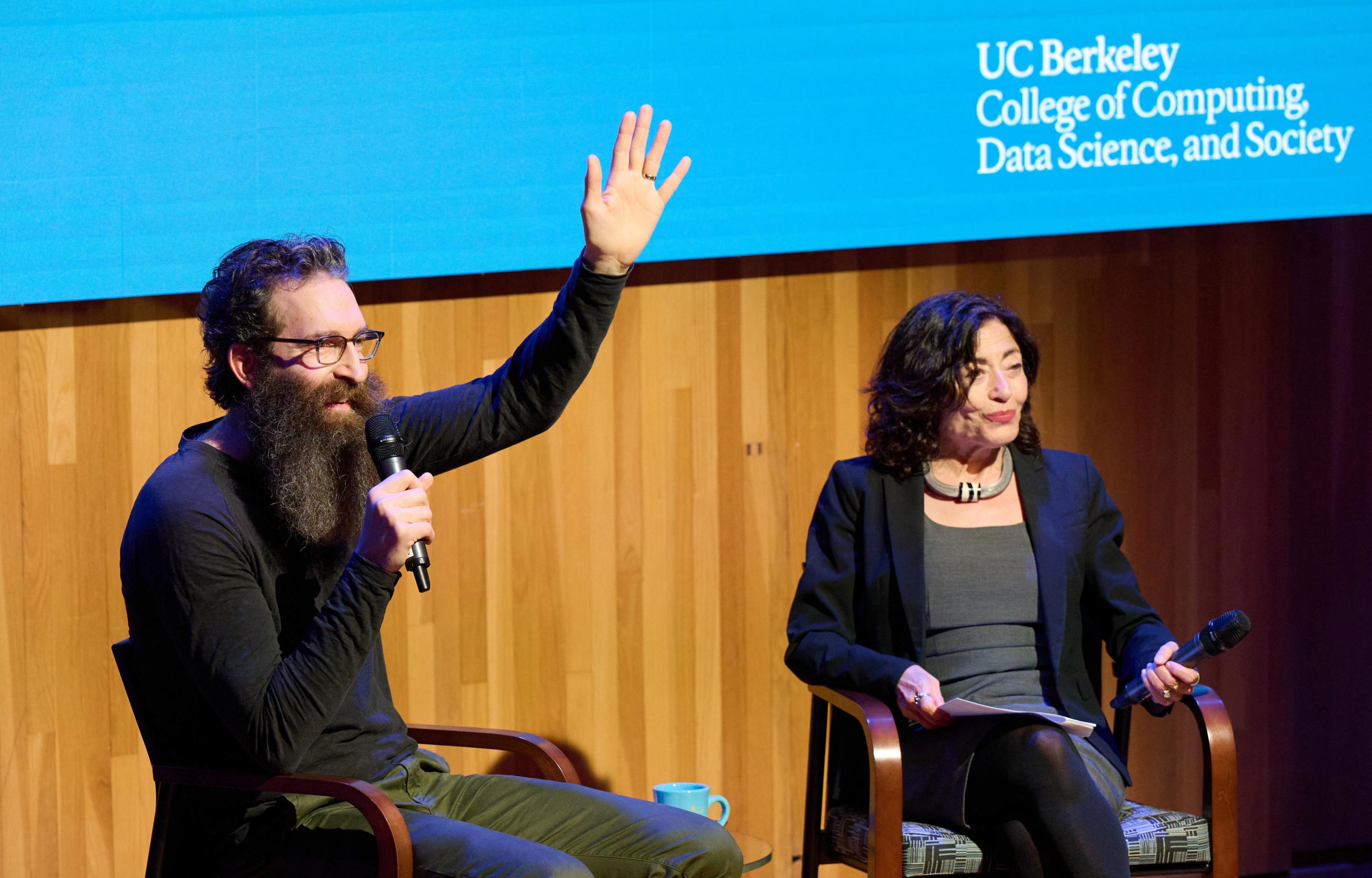
How can we increase opportunities and limit the harms of AI? An event during last weekend’s Berkeley Homecoming considered opportunities and challenges in harnessing the technology for the public good.
Andy Konwinski, serial founder and Berkeley computer science Ph.D. alum, joined Jennifer Chayes, dean of the UC Berkeley College of Computing, Data Science, and Society (CDSS), for a spirited discussion on shaping our AI future.
More than 200 students and their parents, alumni and members of the Berkeley community packed into a full auditorium on Oct. 4 to hear from the AI and computing experts.
'Breakthroughs happen in a place like Berkeley'
Chayes opened the conversation by asking Konwinski to discuss his journey from a Berkeley grad student to his current work.
“My interests sit at the intersection of research, industry and the public good, and that's reflected in the types of organizations that I’m building,” said Konwinski, co-founder of Laude Institute, Laude Ventures, Databricks, and Perplexity.
“I like being part of the process that discovers breakthroughs, things that ultimately can make humanity more prosperous – make us safer, make us more secure, make us healthier, make us live longer, suffer less, be wealthier,” he said. “And those types of breakthroughs happen in a place like Berkeley more than anywhere else in the world.”
Konwinski emphasized the importance of translating research breakthroughs into real-world impact by using metrics like open innovation and open discourse. He asked Chayes about her involvement in founding Berkeley’s college in computing and data science, and why it was important to have “society” reflected in the college name.
An inflection point for AI's societal benefit
“Computer science, data science and statistics... need to be in the service of society,” said Chayes. “We have experienced wave after wave of technological advancement, especially in this century. Some of it has been really beneficial to society and some of it has not been, and we need to get ahead of that. We are now in the most accelerated phase of technological advancement that we have ever seen.
“We are at an inflection point. Society can be the beneficiary of generative AI, and it could also be the victim,” Chayes said. “At Berkeley, we need to show how to lead the way for society to be the beneficiary.” She highlighted opportunities to integrate AI technologies with other disciplines to revolutionize healthcare and create new materials to combat climate change.
Konwinski further reflected on the need for open innovation and investment in institutions.
“I believe our institutions in the West – democracy itself – are in peril,” Konwinski said. “The rallying call to the students in the audience, and the parents who are are here to support them, and the alumni, and everybody is that you have to think about these problems at the biggest level, because if you don’t, you won’t solve them, you'll do something too small, and if you do a small thing, you might succeed.”
“If you do a big thing, you’ll probably fail,” he said. “And that's the trade-off you have to take right now. It’s about your children’s future and your parents’ children's future, it’s about the species. So think about civic discourse. Think about the future of healthcare. Think about science and the way scientific breakthroughs can help us. And pick something really big to work on that you won’t be able to do by yourself.”

Attendees at the event asked questions ranging from the impact of AI on future careers to how to address potential AI risks through regulatory frameworks.
Konwinski discussed four AI impact areas – or “moonshots” – where his nonprofit Laude Institute is focusing its philanthropic efforts: civic discourse, scientific progress, frontline healthcare, and workforce reskilling.
“Researchers need to keep focusing on how to reskill America and the global workforce where it’s a reality that jobs will be displaced by AI,” Konwinski said. “We need researchers to do research… nudge the upside and dampen the downside of these very real areas of our society that AI is going to impact, reskilling being one of them.”
Regarding regulatory frameworks, Chayes discussed Governor Gavin Newsom’s recent signing of California Senate Bill 53, the first state legislation in the U.S. to address the safety and transparency of frontier AI models.
Chayes served on a working group that submitted a report earlier this year, at the request of Gov. Newsom, summarizing the best available evidence on frontier AI and proposing key policy principles to help inform the use, assessment and governance of frontier AI in the state. The report has been cited by California state senators and assembly members, state agencies, tech industry leaders, and civil society organizations.
“[As computer scientists], we need to say what’s technologically possible and what’s not possible, and we need to return to our communities and return to our students and make sure that they understand what’s possible and what’s not possible,” Chayes said. “CDSS has a requirement that every student take a class which is more socially and ethically focused, because you have objectives you are trying to achieve, and this can’t be an objective slapped on at the end. It has to be at the very beginning, on equal footing with your technical objectives.”